01786 841202
 FREE UK tracked delivery
 Order by 12pm Mon-Fri for same day dispatch



Search techniques
by Nigel Williams
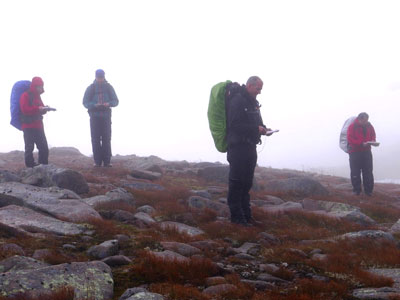
Examples of objectives that might be hard to locate are: large flat topped summits typical of many highland Munros and Corbetts, prehistoric sites, cairns, crosses, shielings, old aircraft wreckage, a small knoll, even your tent or snow hole.
Remember that searching for something on the ground based on a 6-figure grid reference is actually a 100m sq. area. An 8-figure grid should bring it down to a 10m square area. Yes, a phone GPS is the simple answer these days, but they do have vulnerabilities particularly in the conditions of cold and wet where we might need an alternative.
Careful planning and use of attack points and catching features to reduce long distance (around 700m+) bearings, timing or pacing to the objective in the first place should help reduce the need for search techniques. Having an attack point near the objective can be the point from which to initiate a search technique. I recently used a group sweep search from a summit cairn to find a piece of WW2 aircraft wreckage.
Avoid wandering aimlessly at all costs, always have a clear plan so you can return to the original point you stopped at. Pace and use bearings all the time. During the process you will gather useful information and may change the plan as a result but continue cautiously so you know what ground you have or have not covered.
There are 3 methods all requiring pacing and compass skills. Ideally there should be more than one compass available even if there are just 2 of you. Estimating the limit of visibility in terms of pacing and measuring ground visibility is key. Visible and invisible hazards such as cliff tops, cornices, rocky ground, water features etc. can all interfere with the search process.
Anticipation is really helpful if the objective could be difficult to find. Choosing to initiate the process at a point short of the objective is much better than wandering around without a plan until you have little idea of your location, which direction to proceed in and a rough idea of how far you might need to go. Losing control of your position creates stress which will interfere with the neuroglial process required to make sound navigational decisions. It can feel more like an emergency process rather than a useful strategy being used to nail the objective first time.
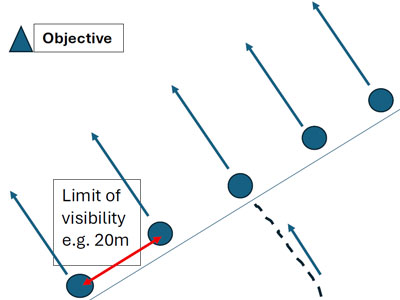
Sweep search requires an estimate of visibility - 20m in this example. That dictates the spacing between the people. Each person in the line should only be able to see the person either side of them in order to cover as much ground as possible.
The group have been walking in the mist on a flat-topped hill (typical of the Cairngorms) on a bearing of 320º. Anticipating they may have drifted off their bearing they decide to stop about 50m short of their estimated distance and spread out with all compasses on the same bearing. The leader blows a whistle or shouts to start the party moving forward trying to maintain the bearing and counting paces as well as keeping the person next to them in sight. When someone spots the top, they shout "stop" and everyone closes in on them so they can go to the top as a group. No one is left walking alone in the mist.
All need to be confident walking on a compass bearing. Any without a compass may be able to help but must keep in sight of a colleague ideally one either side of them. Although there are 5 in this example it can work with 2. If it appears the team has overshot the target they need to turn around and line out to one side of their previous track and walk back across the area, (just using the white end of the needle rather than messing around turning the dial etc).
This technique can also be initiated from a known point on the map and ground.
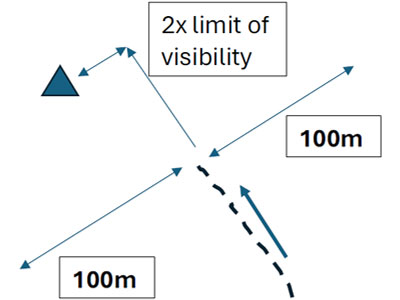
You are solo or the only navigator and have been walking in the mist over difficult ground that may have compromised your bearing and pacing and not yet found the objective. It is tempting to start wandering around all over the place hoping to find it, but that is a poor decision. The search needs to be careful and methodical to keep track of the ground you have searched.
Pace at right angles from your main direction of travel for say 100m in each direction and return to the original line of travel. Then advance forward twice the distance of visibility to avoid searching the ground twice. The 100m in this example is merely based on your gut estimate as to how far off target you might be, the limit of visibility is less important. A hazard, change in the terrain or seeing an identifiable feature may stop you short of that or provide a point from which to approach the objective.
Do not leave your rucksack to provide a target on the return leg, build a small cairn if you like. If you see the objective you don't want to go back to collect, or worse have to search for your sack.
Anticipating it might be difficult to locate the objective and starting the process just before completing the pacing might be wise. That tends to eliminate the stress of thinking you have failed to find it in the first place.
One other point to make here is that you can use the white end of the compass needle pointing to the N on the dial for each return leg.
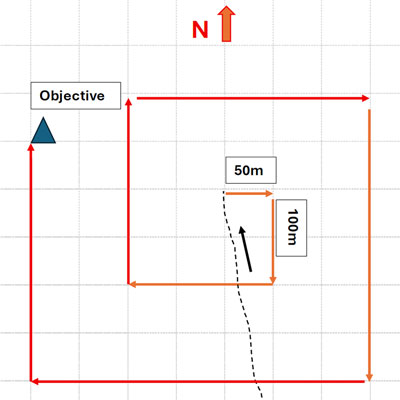
Expanding spiral search requires accurate bearings and pacing.
You are on your own or there is only one compass in the group. You have been walking on a bearing roughly N in the mist over difficult ground where your pacing and accuracy may have been compromised, and not yet found the objective.
The key here is estimating the limit of visibility, 50m in this example. Ideally, you choose a cardinal direction e.g. E and pace 50m, then head S and pace 100m and so on adding 50m on each leg. The limit of visibility measurement ensures that you avoid seeing the ground twice. This method can be disrupted by hazards e.g. rivers or cliffs.
- If you are in need of a compass then we stock a great range of items and other useful navigation equipment, suitable for all levels of navigation.
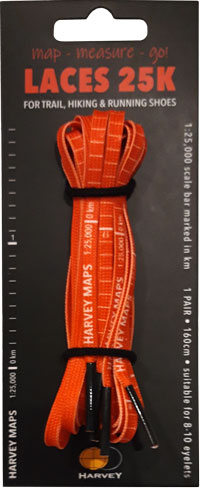
- For the perfect lanyard to go with your compass, the HARVEY Map - Measure - Go! scale bar laces double up to make measuring distance easy! Available in two scales, 1:25,000 scale markings (red) and 1:40,000 scale markings (yellow).
Return to the Navigation Blog